Saturday, March 21, 2009

T-Shirts Tell The Tale


There has been a lot of talk lately about how the Israeli army (and society) has lost its moral compass. The brutality of the Gaza war (and the 2006 Lebanon II war) have brought this to the fore. To see the latest testimony of Israeli soldiers about the lack of moral restraints and ethical reflection - the contemptuous meanness that has crept into the Israeli army - read the soldiers own testimonies as published in Haaretz.

Tons has been written already about these revelations, and there is a not a lot I can add. Two articles stand out however, and are worth a read.

Patrick Martin's piece in the Globe, aptly titled "A Farewell to the Purity of Arms."(And BTW see also my own previous blog entries on Purity of Arms, from October 2008.) Martin ends his article with an observation by Rabbi Dow Marmur (formerly of Holy Blossom Temple in Toronto)

Irving Greenberg said it's incumbent on us Jews to exercise power with a memory of powerlessness, otherwise the history of Judaism will be invalidated.

That is something these soldiers should be told. But, instead, we are sending these young people into wars they can't win; putting enormous pressure on them to finish the job. It's no wonder they shoot to kill everyone.

It's up to Jewish leadership to guard against this.

Yes indeed!

The other interesting piece is Bernard Avishai's piece "Child Abuse", in which he writes:

Let me get this straight. We take 18 and 19-year-olds, young people who are little more than children themselves, and at a time of life when showing the utmost cool is a kind of sexual ante; a time when ideas about the world are largely received wisdoms; when bodies are at their utmost strength but so is the fear of death ... when the people from whom wisdoms are received are parents or mentors loved to the utmost; when minds are just intimidated enough about life's scrum to feel utmost gratitude for family and commonwealth--when the desire to prove one's loyalty is at its most intense.

Then we take these youth ... and tell them that the Arabs, deep down, will never want a Jewish state in the neighborhood; that, in any case, the land is sacred, and giving ground is an utmost sin of Jewish law, as is showing mercy to those who would kill you; that ... terrorism can come in any form, male and female, young and old ...

We tell them, moreover, that the [Arab] civilians ... encouraged the terrorism they must now root out, ... that these Arabs are secretly all waiting and hoping for Iran, the new Amalek, to incinerate Tel-Aviv;... that the strategic goal is to reestablish deterrence, which means scaring the shit out of Arabs, so that they will finally accept the fact that, as former chief of staff Moshe Yaalon put it, they are a "defeated" people ...

Presumably, some European state prosecutor will now want to take our children to the world court. But I wonder: if the court had a social worker, would she not just be threatening to take them away from their parents?
As if to prove his point, I stumbled across these photos in an article in the Hebrew edition of Haaretz. They are of printed T-shirts that soldiers in Israeli army units make for themselves. This is a a long standing tradition in the Israeli army. A way of bonding with your army buddies and showing off to the people back home. I have a unit T-shirt from when I served in the Israeli army. The difference is that these crop logos of are just plan vicious, whereas they used to be merely macho - or, in the case of my unit, humorous.

The sad thing to remember when viewing these army T-shirts, is that Israel has a "peoples army". There is a universal draft, and most young people serve, and are therfore saturated to the culture that produces these shirts. The state of war, the universal military service, the day to day conflict with the Arabs, has been going on for 60 years. It has intensified in the past 40 years (since the occupations of 1967) and then stepped up a notch in the last 20 years (since the first intifada). The results are seen in the stories revealed by soldiers' interviews in Haaretz.

Dow Marmur, in his comments in the Globe, asks: "The important thing to determine is: Were these isolated incidents or widespread behaviour?"

Sadly, I think the T-shirt logos show that the moral rot is deep. Maybe these kids will grow out of it. Or, more probably, they will grow up to be the senior officers, policy makers and educators of tomorrow.

* * *


On the right, a T-Shirt showing a mosque being dynamited, produced for the Sapper's Unit of Battalion 13 of the Golani Brigade. The text reads, "Only God Forgives."

On the left, showing a child in the cross-hairs, a shirt produced for graduates of a Snipers Course. The text reads, "The Smaller, The More Difficult."


Above, a shirt produced for soldiers of the Givati Brigade at the end of 2008. The text reads, "Every Arab Mother Knows That The Fate Of Her Son Is In My Hands" (This text had previously been banned from a T-shirt in another infantry unit.)


On the right, showing a pregnant Arab woman with her belly in the cross-hairs, a T-shirt produced for soldiers in the Sniper Platoon of the Shaked Battalion of the Golani Brigade. The text reads "Sniper Platoon, One Shot Two Kills."

On the left, showing a Samurai, a T-Shirt produced for the soldiers of the Haruv Battalion of the Kfir Brigade. The text reads, "We will not rest until we have confirmed the kill." (A reference to the illegal but common practice of shooting dead, dying, or sometimes just wounded, enemy in the head at close range, to make sure they are dead.)


Above are logos ordered for T-shirts.

On the top, for soldiers from Battalion 13 of the Golani Brigade. The text reads, "Haniyeh, Full cock up the barrel. End of Operation Cast Lead" (Haniyeh is the Hamas Prime Minister in Gaza.)

On the bottom right, for the "Carmon Team" graduates of a reconnaissance snipers' course. The text reads, "You (male) need to run faster. To run faster before you are finished. And later they (female) cry, and later they cry."

On the bottom left, for infantry snipers. The text requires no translation.

* * *
When I lived in Israel, it was not rare (but not common either) to hear people talk like this. But no one (outside of the Kahanists) would have put it in writing and certainly not on a T-Shirt. And certainly not on an army sanctioned T-shirt.

The Haaretz article about the T-shirts did point out that when one of the soldiers went to pick up his T-Shirt at the custom T-Shirt store, he realized that the employee who handed him his shirt was an Israeli Arab. "I felt bad for him," he said.

Maybe, where there is shame there is hope.

Friday, December 22, 2006

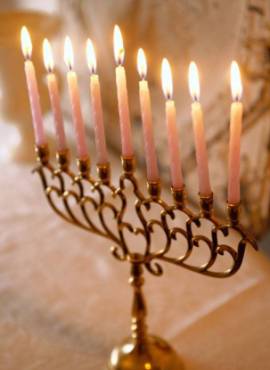
The Challenge of Hanukkah


Hanukkah is a holiday of multiple and fluid meanings.

Originally, it was a holiday celebrating the Maccabees' military victory over the Seleucid Greeks. A war fought not so much for "religious freedom", as against the forces of Hellenization and Jewish assimilation. The war was bloody, and initially, at least, attacked the assimilated Hellenized Jewish elites, as much as, if not more-so than their Seleucid overlords. A reading of the Book Of Macabbees, I and II, makes this clear. Mattathias' cry, which sparked the revolt - "Mi Ladonai Aylai" "He who for God, follow me!" - was, after all, initially directed at a Jew about to sacrifice a pig, and it was that Jew who was the first victim of the revolt.

And so, many people use Hanukkah as a symbol for a militant - and military - religious conservatism and purity, in the face of liberalizing modernity. (See for instance, Michael Medved's article, "The Real Hanukah: A Celebration of the Religious Right" .)


The early Rabbis (or more properly the rabbinic precursors, the Pharisees), de-emphasized the military aspects of the holiday, and instead emphasized the re-dedication of the Temple, and the miracle of the oil. They did this largely because they hated the Maccabbean kings, who, by then, where corrupt and somewhat assimilated themselves, and who opposed the Pharisees' new fangled religious innovations that - ironically - included moving some religious worship away from the Temple and into the Jewish home and synagogue. By putting the emphasis of the holiday on the Temple, on the miracle of the oil, and on Jewish purity and separateness, they could undermine the Kingship, the role of the Maccabees military prowess, the importance of Jewish temporal sovereignty per-se, and at the same time display their loyalty to a hyper-pure Judaism and to Temple worship - but on their own terms. (The Pharisees so wished to repress the Maccabees' role, that the books of Maccabees where not included in the Jewish Bible, and survived only because of their inclusion in Catholic scripture. The Catholics likely preserved these books because of their stories of voluntary Jewish martyrdom in the face of "Greek" religious persecution, something that echoed strongly with the early Christians' own experience of martyrdom at the hands of Rome.)

The later Rabbis - post the destruction of the Temple in 70 AD - subtly changed, yet again, the meaning of the holiday. Even more radically then the Pharisees, they de-emphasized the role of military power. This can be seen in their choice of the Haftorah portion for the first Shabbat of Hanukkah; from Zecahriah chapter 4: ' "Not by might, nor by power, but by my spirit", says the Lord.' - to Zerubavel, the leader of the post Babylonian exile Jewish returnees attempting to re-establish the Temple. In other words - right makes might! Jewish sovereignty will be re-established only by way of ethical, godly behavior. Military power and sovereignty (alone ?) will not do it. Furthermore, rather than emphasize the xenophobic and militant "us versus them elements" of previous understandings of the holiday, they acknowledge that the Temple (and by extension Jewish sovereignty) can best be established when the Jews live in harmony and cooperation with their neighbours. Thus, the Haftorah portion chosen for the second Shabbat of Hanukkah - which will be read in synagogues around the world tomorrow; from I Kings chapter 7: '... So Hiram (King of the Phoenicians) finished all the work that he had been doing for King Solomon on the House of the Lord.'

The early Zionists, consciously re-emphasized the military elements of the Hanukkah story. But they re-cast it as primarily a national struggle, not a religious one. The elements of religious Jews fighting assimilated Jews are completely absent; and the Temple and the miracle of the oil are, at best, cute side-bars. The Maccabees' bravery, strength and military effectiveness are front and centre, as is the "victory of the few over the many." God, and godliness are absent.


Contemporary North American liberal Judaism has yet again re-constructed the meaning of Hanukkah. This time into a holiday of religious freedom, of tolerance and of multi-culturalism. The Maccabees' struggle is now understood to be about the right of the ancient Jews to worships as they wanted, and not to be forcibly assimilated into the majority culture.


Many of these meanings will ring true to us. Some will be anathema. The challenge of Hannukah is to decide what the deep meaning of the holiday is for us. What is it that WE are affirming? Tolerance, and faith in the power of the good? Or, faith in the power of military power, and need to stay apart? Or some combination of these themes?


Sunday, October 05, 2008

Purity of Arms - RIP


Tahart HaNeshek - 'Purity of Arms' - is a phrase used in the Israel to depict the morality of the Israel Defense Forces. It defines the rules of engagement that tell Israeli soldiers they may not kill of brutalize "enemy non-combatants" (i.e. civilians.) The IDF used to be very proud of its taharat ha neshek. It distinguishes "us" from "them". They target civilians - we never do. They shoot prisoners and ignore the Geneva conventions - we never do.

One of the shameful tragedies of the second Israel - Lebanon War was the IDF's massive use of cluster bombs. Cluster bombs explode about 100 meters above the ground, and scatter hundreds of smaller 'bomblets' around a large area. These, in turn, explode - or are supposed to explode - on contact with the ground. It is the 'bomblets' that do the intended killing. Cluster bombs are designed to be used against personnel - when you "don't have an exact target". They kill or maim anyone vaguely close to the target. With cluster bombs, "collateral damage" is a known and planned effect. But not only are cluster bombs designed to kill anyone within several hundred meters of the "target", they leave a deadly legacy - not dissimilar to land mines - that kill and maim civilians for months and even years after the war is over. The U.N. has estimated that there were over 1 million (that's not a typo!) unexploded cluster 'bomblets' left scattered around southern Lebanon after the last war: just waiting for a child to kick one, or pick one up, or an unsuspecting adult to accidentally step on one.

There is a growing chorus of countries demanding that cluster bombs be banned. Over 100 countries, so far, have agreed to banning them. America, Russia, China, and Israel have refused. (Oh, how proud we are to be among the "Big Boys"!)

But Israel has not done nothing. It has built a better cluster bomb! - to salve its conscience perhaps, as well as to be more effective in the initial blast. According to this story from Reuters, the new Israeli manufactured cluster bomb leaves only 10% of its 'bomblets' on-exploded: as opposed to about 35% in the American made munitions Israel has been using until now. So that means only 300,000 unexploded bomblets next time around. Praise the Lord!

Is this the tshuvah Israel is doing for the excesses of the second Lebanon War? If so we better hope God has lowered his standards. To quote Isaiah from the Yom Kippur Haftatah: "Is this the fast I require?"

* * *

As if to underscore it's now complete abandonment of the concept of taharat ha neshek, - civilians and civilian infrastructure are now declared legitimate targets of the IDF.

A recent interview with the IDF's GOC Northern Command Gadi Eisenkot, as well articles written by two senior reserve officers, emphasize that the next Lebanon war will be just like the last - only more so. The IDF will increase its "firepower" and target Lebanese civilians. The details can be found in this article from Haaretz. Some typical quotes:

Eisenkot presented his "Dahiyah Doctrine," under which the IDF would expand its destructive power beyond what it demonstrated two years ago against the Beirut suburb of Dahiyah, considered a Hezbollah stronghold.

...

"We will wield disproportionate power against every village from which shots are fired on Israel, and cause immense damage and destruction. ... This isn't a suggestion. This is a plan that has already been authorized."

...

"[The IDF will deal] a disproportionate strike at the heart of the enemy's weak spot, in which efforts to hurt launch capability are secondary. ...

"This strike has to be carried out as quickly as possible, through prioritizing strikes at its assets, rather than chasing after launch sites.

...

Israel [should] pass a clear message to the Lebanese government, as soon as possible, stating that in the next war, the Lebanese army will be destroyed, as will the civilian infrastructure.

"People won't be going to the beach in Beirut while Haifa residents are in shelters,"

...

While Eisenkot and Siboni deal primarily with striking Shi'ite strongholds, Eiland sees Lebanon's infrastructure as a primary target, in a plan highly reminiscent of the one proposed by then-IDF chief of staff Dan Halutz, which was eventually shot down by U.S. opposition.

...

What the three officials have in common, surprisingly, is their emphasis on air power. Anyone who thinks the Air Force will step aside given the results of the last Lebanon war will likely be proven wrong.
* * *

Can anyone stop this madness? Whatever happened to:

"When you shall besiege a city a long time, in making war against it to take it, you shall not destroy its trees by forcing an ax against them" (Deut 20:19)

or

"Not by might, nor by power, but by my spirit, says the Lord of hosts." (Zezhariah 4:6)

or just the official IDF doctrine (though poorly enforced) of the 40's, 50s, and 60s?

Friday, October 31, 2008

15 Minutes of Fame


Two weeks ago I wrote a letter to the Canadian Jewish News, and to my surprise they actually printed it!

You can see it at the CJN web site - as they edited it (scroll to the bottom of the page) - or you can read the original below. Though they retained the gist, they edited out the passion - IMO. But I am glad that they saw fit to allow a different voice to be heard on their pages.


We should be ashamed.

As Jews we should be ashamed of the IDF's new military doctrine, as explained in your front page article: "What are the IDF's plans for the next war?" (October 16).

It is clear from the article, that in the event of another war in Lebanon, the IDF plans to use massive and "disproportionate" force to destroy Lebanon's civilian "assets".

"We will wield disproportionate power against every village from which shots are fired on Israel, causing immense damage and destruction." says the head of the IDFs Northern Command. The goal, he goes on to say, is to strike at Lebanon's "weak spots" and "efforts to hurt [the enemies missile] launch capability are secondary". In case the point is not clear, the plan is called "the Dhaliyah Doctine" after the Shiite neighbourhood of Beirut that the IDF effectively destroyed in the last Lebanon war. We therefore are no longer talking about "collateral damage", but a deliberate targeting of civilians and civilian infrastructure

What ever happened to the IDF doctrine of "Purity of Arms" (taharat haneshek) whereby Israeli soldiers where explicitly forbidden to target civilians? More to the point, whatever happened to the Biblical injunction not to destroy the economic infrastructure (e.g. fruit trees) during war? To quote the Eitz Hayim Chumash (standard in the Conservative Movement) on this verse:

"We are not to be so carried away in times of war that we forget that
the war will be over one day, and people will have to live and feed
their families in the place where the battles are raging. Beyond that Maimonides writes: "Not only one who cuts down a fruit tree, but anyone who destroys household goods, … demolishes a building, stops up a spring, or ruins food deliberately, violates the prohibition of bal tashchit ."

How, in fact, is the IDF's new doctrine - of bringing the war to the
Beirut's civilians - different than the doctrine of the Palestinian
terrorists who wish to bring their war against the occupation to the streets of Tel Aviv?

Israel must hold itself to a higher standard than the terrorists. To
quote the Dry Bones cartoon that appears in the same Oct 16th issue of
the CJN, "On Simchat Torah we express our joy at having received the
burden of morality". That is something I would like to believe about
our Jewish People. In light of the IDFs new doctrine, however, that
appears as a bad joke.

I pray that the IDF will change these immoral plans, and I
urge all Jews to encourage it to do so.


Saturday, September 13, 2008

Culture, Religion, and Why People Vote Republican


The photo above is of Emile Durkheim, influential French-Jewish sociologist (and son of a Rabbi). His theory of Religion heavily influenced Rabbi Mordecai Kaplan, founder of Reconstructionist Judaism.


Friday morning I stumbled across this article that tries to explains why people vote Republican - in terms of the religious motivation. Being someone who "suffers" from the religious motivation myself, I found this article both interesting and ringing very true. Below is an excerpt.

Here's my ... definition: morality is any system of interlocking values, practices, institutions, and psychological mechanisms that work together to suppress or regulate selfishness and make social life possible. It turns out that human societies have found several radically different approaches to suppressing selfishness, two of which are most relevant for understanding what Democrats don't understand about morality.

First, imagine society as a social contract invented for our mutual benefit. All individuals are equal, and all should be left as free as possible to move, develop talents, and form relationships as they please. The patron saint of a contractual society is John Stuart Mill, who wrote (in On Liberty) that "the only purpose for which power can be rightfully exercised over any member of a civilized community, against his will, is to prevent harm to others." Mill's vision appeals to many liberals and libertarians; a Millian society at its best would be a peaceful, open, and creative place where diverse individuals respect each other's rights and band together voluntarily (as in Obama's calls for "unity") to help those in need or to change the laws for the common good.

Psychologists have done extensive research on the moral mechanisms that are presupposed in a Millian society, and there are two that appear to be partly innate. First, people in all cultures are emotionally responsive to suffering and harm, particularly violent harm, and so nearly all cultures have norms or laws to protect individuals and to encourage care for the most vulnerable. Second, people in all cultures are emotionally responsive to issues of fairness and reciprocity, which often expand into notions of rights and justice. Philosophical efforts to justify liberal democracies and egalitarian social contracts invariably rely heavily on intuitions about fairness and reciprocity.

But now imagine society not as an agreement among individuals but as something that emerged organically over time as people found ways of living together, binding themselves to each other, suppressing each other's selfishness, and punishing the deviants and free-riders who eternally threaten to undermine cooperative groups. The basic social unit is not the individual, it is the hierarchically structured family, which serves as a model for other institutions. Individuals in such societies are born into strong and constraining relationships that profoundly limit their autonomy. The patron saint of this more binding moral system is the sociologist Emile Durkheim, who warned of the dangers of anomie (normlessness), and wrote, in 1897, that "Man cannot become attached to higher aims and submit to a rule if he sees nothing above him to which he belongs. To free himself from all social pressure is to abandon himself and demoralize him." A Durkheimian society at its best would be a stable network composed of many nested and overlapping groups that socialize, reshape, and care for individuals who, if left to their own devices, would pursue shallow, carnal, and selfish pleasures. A Durkheimian society would value self-control over self-expression, duty over rights, and loyalty to one's groups over concerns for outgroups.

A Durkheimian ethos can't be supported by the two moral foundations that hold up a Millian society (harm/care and fairness/reciprocity). My recent research shows that social conservatives do indeed rely upon those two foundations, but they also value virtues related to three additional psychological systems: ingroup/loyalty (involving mechanisms that evolved during the long human history of tribalism), authority/respect (involving ancient primate mechanisms for managing social rank, tempered by the obligation of superiors to protect and provide for subordinates), and purity/sanctity (a relatively new part of the moral mind, related to the evolution of disgust, that makes us see carnality as degrading and renunciation as noble). These three systems support moralities that bind people into intensely interdependent groups that work together to reach common goals. Such moralities make it easier for individuals to forget themselves and coalesce temporarily into hives, a process that is thrilling, as anyone who has ever "lost" him or herself in a choir, protest march, or religious ritual can attest.

According to the author - Jonathan Haidt - the Democrats are the party of John Stuart Mill and the Republicans the party of Emile Durkheim. Later in the article he writes:

...the second rule of moral psychology is that morality is not just about how we treat each other (as most liberals think); it is also about binding groups together, supporting essential institutions, and living in a sanctified and noble way. When Republicans say that Democrats "just don't get it," this is the "it" to which they refer.

Well it is certainly something I get. So I do wonder: why don't more liberals get it?

Maybe there is more need for the a Network of Spiritual Progressives than I thought. Why can't liberal religions - Reconstructionist and Reform Jews, Quakers and Unitarians and Methodists (and the Anglicans and United Church In Canada), Bahais and Ahmadiyyas and Ismaeli Muslims, and other progressive religious types have as much influence in the Democratic Party, and left politics in general, as evangelicals do in the Republican Party. And why do liberals politicians, indeed "not get" religious values and motivations? There is nothing intrinsically left or right about religion. Religious people where at the forefront of of the anti-slavery movements in 19th century England and America. And most religions preach some variant of the social responsibility that is the core message of the economic left.

Maybe its because most "liberals" leaders are too cerebral, and have to little "gut". Or maybe its because they think they are preaching to the "rational" self interest of their voters, when in fact they should be appealing to the electorates deeper desire for social solidarity and transcendent meaning.

Saturday, May 31, 2014

Piety in Post Hurban Times


Below is a slightly edited version of a dvar Torah I gave at my synagogue earlier today.

I want to thank my fellow congregant Mark Matchen for some of the ideas regarding the discussion of Mishna  Nazir 5:5 below; and Rabbi Arthur Waskow and Neil Litt for some the ideas regarding the discussion of Nazir 5:4.


Dvar Torah, Parshat Naso,
31 May 2014, 2 Sivan 5774
Sydney Nestel
Shabbat Shalom,
Today’s parsha is Naso, the second parsha in the book of Numbers. The parsha deals with a number of seemingly disconnected topics. It begins with a continuation of the census that Moses was commanded to perform in last week’s parsha. It then goes on to tell us the laws regarding anyone who has become ritually impure, either by cause of a skin disease, or contact with the dead. The parsha then instructs us in a principle of Biblical law: anyone who causes financial harm to another must make full restitution, plus pay an extra fifth as atonement.
Next the parsha discussed the law regarding the suspected adulteress: the famous case of the Sotah, whose guilt or innocence is to be determined by a ritualized trial by ordeal. The parsha, then goes on to tell us about the laws of the Nazirite – or temporary monk – someone who voluntarily takes upon themselves extra responsibilities of holiness. Next the parsha commands Aaron and his sons to recite the Priestly Blessing: the same blessing that we at Darchei Noam say to each other, every Shabbat, as we embrace each other in our tallitot.
Then the parsha tells us – in excruciating detail, 88 verses in all – about the offerings that the chiefs of Israeli brought to the consecration of the Miskkan. And finally the parsha ends by telling us that Moses enters the Tent of Meeting to talk to God, who speaks to him from between the Cherubim.
* * *
It was hard to find an overarching theme in this parsha on which to base this dvar Torah
The theme of a census, in the opening of the parsha, tempted me to focus my remarks around the Canadian governments’ dismantling of Statistics Canada – but I rejected this idea as being perhaps too current and too controversial for a dvar Torah.
The theme of the Sotah – or suspected adulteress – also was tempting. There is certainly a lot of material to be mined there. But frankly this topic has been addressed so many times at our shul that I thought there was nothing new I could say on the subject.
So I decided to base this dvar around the perhaps arcane topic of the Nazirite – or for lack of a better term, the monk – the person how takes upon themselves an elevated commitment to holiness. Or is it holiness? And that is one of the questions we will address.
The parsha tells us, in Numbers chapter 6:
1 And the YHWH spoke unto Moses, saying:
2 Speak to the children of Israel, and say to them: When either man or woman shall clearly utter a vow, the vow of a Nazirite, to consecrate himself unto the YHWH,
3 they shall abstain from wine and strong drink: they shall drink no fermentation of wine, or fermentation of other strong drink, neither shall they drink any grape juice, nor eat the fresh grapes or dried grapes.
4 …
5 All the days of the vow of Nazirite-hood no razor come upon his head; until the days which he has consecrated himself to YHWH be fulfilled, he shall be holy, he shall let the locks of the hair of his head grow long.
6 While he is consecrated to YHWH he shall not come near a dead body.


We see several things here. First, both men and women can become Nazerites.
Second, in order to become a Nazerite one must make a clear – and presumably voluntary – vow.
Third, that the Nazerite gets to declare, as part of their vow, the length of their Nazerite-ship. It could be for a month, for a year, or for life if they choose.
Forth, there are three specific obligations that a Nazerite takes on:
  1. not to drink wine or any fermented product or eat or drink any grape product;
  2. not to cut their hair; and
  3. not to have any contact with , or even be physically close to, the dead.
As we shall see this last prohibition is particularly strict.
The parsha text goes on.
7 Because his consecration unto God is upon his head, he shall not make himself unclean when they die for his father, or for his mother, for his brother, or for his sister.
8 All the days of his Nazirite-hood he is holy to the YHWH.


These two verses, echo the obligations of the High Priest. And they emphasis the obligation to be holy to God – which is presumably the point of the whole exercise.
But being a Nazerite has some additional costs, and it is not always easy to end the period of Nazrite-ship on schedule as planned The Torah goes on:
9 And if any man die very suddenly beside ... [the Nazerite], and he defile his consecrated head, then he shall shave his head ….
10 And on the eighth day he shall bring two turtledoves, or two young pigeons, to the priest, to the door of the tent of meeting.
11 And the priest shall prepare one for a sin-offering, and the other for a burnt-offering, and make atonement for him, for he has sinned …
12 And he shall re-consecrate to YHWH the all the days of his Nazirite-ship, ...; and the former days [of his Nazerite-ship] shall be void, because his holiness was defiled.


Thus if you accidentally violate one of your Nazerite restrictions – you have to bring several sacrifices. But perhaps more importantly, you have to start the entire period of your Nazerite-ship all over again. So being a becoming a Nazerite, involves a serious commitment to following the rules. Or at least it was supposed to.
Finally, ending one's Nazerite-ship involves several more sacrifices, and therefore more commitment of time and money.
13 And this is the law of the Nazirite, when the days of his consecration are over: he shall come to the door of the tent of meeting;
14 and present his offering to YHWH, one young male lamb without blemish for a burnt-offering, and one young female lamb without blemish for a sin-offering, and one ram without blemish for peace-offerings ...


The text goes on for several verses with the details of the sacrifices and then concludes.


20 And the priest shall wave them for a wave-offering before YHWH; … and only after that the Nazirite may drink wine.


So, to end the period of his Nazerite-ship the Nazerite has to bring 3 animals as well as bread, oil, and wine and and his shaven hair. Only after the priest has made sacrifices of these, is the Nazerite free to resume his former life.
The rules seem pretty clear. And the purpose too, is pretty clear – to give pious people a chance to publicly express their piety – to do more then what is normally expected – but in a time limited way. Today, I would compare Nazir-hood to the practice of temporary monk-hood that is common in some Buddhist societies.
Or perhaps, if we remove the temporary aspect, Nazir-hood is akin to the Haredim – who take on obligations of dress, hairstyle, and behaviour, which they admit are not strictly speaking halachik , but which publicly express what they see as their extra level of piety. And, who like the Nazir, who avoided the temptation of wine, avoid all manner of temptations in the secular world.
Of course, given that Nazir-hood is linked to the Temple system, there have been no formal Nazerites since the destruction of the Second Temple. But what do we know of Nazerite-hood in the days when the Temple still stood. The answer is “not much. “ And what we do know is more from what is recorded in the Talmud about Nazerites in the late Second Temple period, than from what is recorded in the Hebrew Bible regarding Nazirites in the First Temple or early Second Temple periods.
In fact, outside of this week’s parsha, the word “Nazir” is only mentioned in two other instances in the entire Tanach. Once it is mentioned in a speech by the prophet Amos, without reference to any particular person. And, the word comes up a few times in the story of Samson – the only person in the entire Tanach, clearly identified as an actual Nazir.
But Samson – though he is clearly labelled a Nazir by the text – follows nearly none of the rules of Nazir-hood as laid out in this week's Parsha. Firstly, as you will notice if you follow today’s haftarah – he never takes a vow – let alone a voluntary vow – to become a Nazir. Rather an angel appears to his mother before she conceives and tell her that she will have a son and that he will be a Nazir. Furthermore, It is his mother who is enjoined not to drink wine, and additionally and somewhat surprisingly, not to eat anything unclean. (Aren’t all Jews forbidden to eat “unclean” foods.)
Samson is explicitly forbidden to cut is hair. But as for the rest of the Nazirite prohibitions – it seems unlikely that he kept them. It is told that he killed 30 Philistines and took their clothing; later he killed several more Philistines in revenge for them having killed his wife and father-in-law (which, by the way, the Philistines did in revenge of Samson having burned their crops, which Samson did because he was angry at his wife’s adultery with a Philistine.) Still later we are told that Samson clubbed 1000 Philistines to death with the jaw bone of an ass. With all this killing, it is unlikely that he avoided touching the dead. We are also told that he liked the ladies, and frequented Philistine prostitutes. It seems unlikely, in such circumstances, that he avoided strong drink.
And as for Samson’s piety – his entire life seems one of impulse and swagger and violence, from his marriage to a Philistine woman, to his dangerous betting, to his impulsive acts of revenge, to his affair with Delilah, to his foolish revelation of the secret of his strength, to his suicide murder (dare I say “suicide bombing”) at a Philistine feast, killing 3000 Philistines, in revenge for their tormenting him. This is hardly piety, or holiness, as most of us would understand it. And indeed it is not clear, whether the Tanach wants us to see Samson as a hero, or as a fool – an example of the weak and immoral leadership of the Israelites during the period of the Judges: a leadership crisis that, in the eyes of the Biblical author, justified the establishment of a monarchy to suppress the religious anarchist currents deep within Judaism, and which too often, perhaps, bubble to the surface.
We see, therefore, that the sole example of a Nazir in the entire Tanach, hardly comports to the model laid out in the Torah. Is there then any evidence that Nazir-hood was ever carried out as envisioned in our parsha? Yes there is: - sort of.
This evidence comes to us from the from the Talmud, and recalls the late Second Temple period. The Talmud devotes an entire tractate to the topic of the Nazir. This alone should tell us that Nazir-hood was a real phenomenon in the early Mishna period.
But Rabbinic attitudes to the Nazerite are complex. Some of the Rabbis argue that Nazir-hood is primarily sinful. That is why the Nazir has to bring a sin offering at the end of his period of Nazir-ship. But what is the nature of this sin?
According to these Rabbis, the sin of the Nazir is that he forbids himself what the Torah has permitted. Because of his own fears that he cannot control himself, he needlessly denies himself both pleasures and grief. The Nazir sees a world of temptation and corruption, a scary world he does not want to be sucked into. So, he says "I will have no part of this - I will not corrupt myself in that way!" And he puts in place mechanisms to maintain his own purity and correct behaviour. However, what has he actually accomplished? Has he changed any of the things that bothered him about society? Has he helped others to overcome temptation? No. And therein lies his sin.
But other Rabbis see Nazir-hood as a genuine and positive way to express piety and the love of God. In support of this they bring theoretical arguments, but also a postive example: Queen Heleni – or in Hebrew, Heleni Hamalkah.
Mishna Nazir 3:6 reads:
One who [made a] Nazirite [vow] for a long time period and he finished his period of being a Nazirite, and then he came to Israel, Beis Shammei say, "He must become a Nazir for thirty [additional] days" and Beis Hillel say, "He must become a Nazir from the beginning." It is told of Heleni the Queen, that her son went to war and she said, "If my son comes [back] from war in peace, I will be a Nazir for seven years." And her son came [back] from war and she was a Nazir for seven years. And at the end of seven years she moved to Israel and Beis Hillel ruled that she should be a Nazir again for seven more years. And at the end [of these] seven years, she became Tamei / ritually impure by contact with the dead [making her repeat her Nazirut again]. And it ended up being that she was a Nazirah twenty one years. But Rabbi Yehuda said, "She was only a Nazirah for fourteen years".
Heleni Hamalkah is a real historical figure. She was the Queen of Adiabene, in what is now Kurdistan. In the first century she converted to Judaism along with a large number of her people – perhaps the source of Kurdish Jewry. And she really did move to Jerusalem. And she contributed from her great wealth to the Temple, donating among other things a famous golden candlestick and a large golden plate. She also sent to Alexandria for grain and to Cyprus for dried figs for distribution during a famine. In another Talmudic passage we are told she built a Sukkah 20 cubits high, which, though it was higher than Rabbinic law allowed, no Rabbi would condemn, and many attended the dinners she hosted in it. Her tomb, and that of her sons, can still be found in what is mistakenly called “the Tomb of the Kings”. You can visit it at the corner of Salach-a-Din Street and Nablus Road in East Jerusalem. There is also a street named after her. Rehov Heleni Hamalkah, is a narrow cobblestoned street that runs from Rehov Haniviim to Jaffa Rd. just behind Migrash HaRussim in West Jerusalem. As all this attests, she was well-loved, and truly pious. Perhaps a bit showy – but nevertheless someone to be admired. A good example of a Nazir – or in her case a Nazirah.
Of course the rabbis who saw Nazir-hood as problematic or sinful have counter-examples. The Talmud, tractate Nazir 4b, tell us that Simon the Just – a priest and a Rabbi – declared that only once in his life had he accepted the sin offering of a Nazir who had broken his vows. In all other cases he felt that they were insincere, and were just using the sacrifice to get out of the strictures they had so publicly placed on themselves. He also felt that most of these Nazirim would, in fact, not re-start the period of their Nazirite-ship as prescribed in the Torah. He thus refused to accept their sin offering and be part of the charade.
In another incident, Mishna Nazir 5:5 tells us
Six people were travelling on the way and someone was approaching them [in the distance]. The first says, "I am Nazir if that is so and so." The second says, "I am a Nazir if that is not so and so." The third says, "I am a Nazir if any one of you is a Nazir." And the forth says, "[I am a Nazir] if none of you are a Nazir." The fifth says "[I am a Nazir] if any two of you are a Nazir." And the sixth says, "[I am a Nazir] if all of you are a Nazir".

Beis Shammei say, "They are all a Nazirim". Beis Hillel say, "No one is a Nazir unless their words come true". Rabbi Tarfon says, "None of them is a Nazir".
Aside from sounding like an SAT word logic puzzle, what is going on here? Ostensibly, this is a legal debate about the validity of conditional vows of Nazerit-hood and perhaps conditional vows in general. Bet Hillel allows them, and Bet Shammai, and Rabbi Tarfon do not.
But look a bit deeper. Two of these travellers – numbers 4 and 6 can never have their words come true, so while they are seemingly making a big show of piety, they know – or should know – that they risk nothing by their declaration. Two of these – numbers 3 and 5 – will always have their words some true, so their conditions are meaningless or stupid, and two of these are simply betting on becoming Nazir – a sort of holier than though game of chicken. Bet Hillel, are the liberals here, letting adults do as they wish so long as no one else is harmed. But Bet Shammai, feels that this type of gamesmanship is against the spirit of piety required by the Nazir and ruins the institution of Nazirit-hood. They aim to stop it, by making anyone who plays such games become a Nazir regardless of their silly conditions. Rabbi Tarfon, agrees with Bet Shamai that this kind of conditional vow is against the proper spirit of Nazirit-hood. But instead of punishing, he says such vows simply don’t count. If you want to become a Nazir do it right – unconditionally and with a full heart.
But aside from these conflicting positions on the validity of conditional vows – we learn something else from this Mishna – namely, that conditional vows for short periods of Nazir-hood were fairly common in the late Second Temple times: A common public display of piety. But, was it real piety or was it just for show – at least some Rabbis thought it was mostly for show.
I want to end with one final Talmudic discussion Nazir-hood which I thought was appropriate given that earlier this week we marked Yom Yerushalayim. Mishna Nazir 5:4 tells us:
… This is the mistake that Nachum the Mede made when the Nazirim came up [to Jerusalem] from exile [to make there sacrifices to end the period of Nazirite-ship] and found the Temple destroyed. Nachum said to them, "If you had known that the Temple was destroyed, would you have [sworn to be] Nazirim?" and they said to him, "No!" and he permitted them [to annul their vows]. But when the matter came to the Sages, they said to him. "[The law is that] anyone who [swore to be] a Nazir before the Temple was destroyed is [still] a Nazir and [anyone who swore] after the Temple was destroyed is not a Nazir.
In the ensuing Talmudic discussion, the disagreement comes down to the question: can one annul a vow which was made based on false information. The accepted principle, is that if there is information that is generally knowable, and you did not know it when you made your vow, you can annul the vow – presumably because one should not be penalized for having less information than was available, or knowing less than one’s neighbour. But if the fact that makes you want to annul your vow - was completely unknowable at the time of the vow, or if the event was completely unpredictable at that time, than you cannot claim an exemption, and your vow stands.
But, it turns out, the Rabbis are divided on whether the destruction of the Temple was predictable. The Sages say that it was not, so the Diaspora Nazitites in our Mishna cannot annul their vows, and since they also cannot now bring the sacrifices required to end their period of Nazarite-ship, (the Temple being destroyed) they must remain Nazirites for life. (Considering that the Sages lived through the long war and the corruption and infighting leading up to the destruction, this is a somewhat surprising position.)
Rav Yosef, arguing in support of Rabbi Nachum position, believes that the destruction was predictable. He bases himself on a verse in Jeremiah chapter 7
“Trust ye not in lying words, saying: The temple of the Lord, the temple of the Lord, the temple of the Lord,”
– which he understands to predict the destruction of the first , the second, and it would seem even the Third Temple. The context of the verse in Jeremiah is clear but stark:
“[If Israel] executes justice between a man and his neighbour; [if Israel] oppresses not the stranger, the fatherless, the widow, and sheds not innocent blood”
Than, God – and Israel – will dwell in the land forever. But since Israel has trusted in “lying word” - that is, the mere existence of the Temple, to protect them, and since they in fact
“[they] steal, murder, and commit adultery, and swear falsely, … [and allow] Jerusalem to become a den of robbers”
then Jerusalem and the Temple will be destroyed.
Rav Yosef, argues that, that based on Jeremiah, the destruction of the second Temple was predictable to anyone with enough insight to see. And therefore, the vows of the Mishna’s Nazerites may be annulled. They are off the hook: they do not need to be Nazerites for life.
Is there a deeper meaning to this Talmudic passage, beyond the technical issue of annulling vows?
Maybe the real tragedy for our Mishna's Diaspora Nazerites is not that they cannot get out their Nazerite vows, but that they cannot intellectually or emotionally get over the fact that the holy Temple no longer exists. These are pious people after all. People who publicly took on extra trapping of piety – in service of a religion that in their mind was based around Jerusalem and around the Temple. They probably looked forward, their whole lives to making pilgrimage to Jerusalem and experiencing its spiritual high and ethical excellence. But when they got there, it was all gone. “How could this be?” they must have asked themselves. What shall we do? Oy vavoy vavoy!
If the destruction was, as the Sages say, completely unpredictable: the product of some fluke, some petty jealousies among the Jews, or some misguided nationalism on the part of the Zealots, or poor tactics by Jerusalem’s defenders, or a random assassination of a good leader by the Sikarrii, then indeed the destruction of their dream of the spiritual Jerusalem, the source of Jewish hopes and identity, the light unto the nations – is truly un- understandable. Our Nazities are stuck carrying out a dead piety based on outmoded concepts – one that can never end for them, but also one that will give them little meaning and no sense of salvation.
But, if as Rav Yosef argues, the loss of Jerusalem as a spiritual centre was entirely predictable, and indeed was predicted by people with clear vision – prophetic vision to be sure: if all this happened, as the prophets had predicted, for a reason, because of the meanness of the society to the stranger and to the weak, because robbery and murder were condoned, because instead of trying to walk in Gods ways Jerusalem put its faith in empty symbols - ancient stones: if that is the case, if this was all predictable, than the maybe, just maybe, the Mishna’s Nazerites can make sense of the spiritual vacuum they have found where the Temple once stood. Maybe they can get out from under their Nazerite world view, and their outdated understanding of Jewish piety, and maybe they can begin creating a new Jewish understanding and a new Jewish practice for new Jewish times: One that is based on the vision of our prophets: working for truth, justice and peace; feeding the hungry and clothing the naked.
Perhaps this, rather than being bitter over the exile and pining for lost glory and an imagined holy past, is what is really required as the new Jewish piety for this post destruction – post Hurban – era.


Thank you, and Shabbat Shalom.


Labels: , ,